
What to look out for when buying a used car?
When buying a used car, from a legal perspective, you primary concern should be the same as from a buyer's perspective: the condition and conformity of the car.
However, the legal side requires a more detailed inspection:
First, clarify who the owner of the used car is. It is a common occurrence for a used car dealership to sign the sales contract, even though they are not the owners. The problem with this is that it misleads the buyer, who might think that if there is a problem with the car, they should contact the professional and knowledgeable dealership; however, this is not the case. Legally, if the seller is not the dealership, action can be taken against the actual seller, who will not necessarily help resolve the car's issues. The other issue is that if we buy the used car from a business (used car dealership), the warranty period is longer, meaning they are liable for defects for a longer period than if we were buying from a private individual.
Attention must also be paid to recording all essential data in the contract, in particular the details of the contracting parties, as well as the vehicle identification number (VIN/chassis number), mileage, license plate number, and registration certificate number of the used car to be purchased. This also makes it easier for us to eliminate potential future problems.
Record the exact purchase price in the contract and do not try to play tricks with it, as it can easily lead to trouble or difficulty. For example, if a lower purchase price is recorded and it later turns out that the car is defective, the seller will gladly argue that they sold it so cheaply because it was defective. In such a case, the burden falls on us to prove that we did not actually pay that amount—and this is often impossible to prove.
Sign the contract in the presence of 2 witnesses, and have the witnesses sign it as well. This way, the contract will qualify as a private document with full evidentiary force.
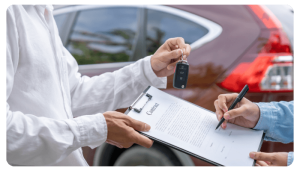
After signing the contract, take it to the local government customer service office (Kormányablak) as soon as possible so that the authority can record the change of ownership. A common problem is that one of the parties fails to submit the contract to the government office, the change of ownership is not recorded, and suddenly a letter arrives from the highway operator stating that you are being fined for driving on the highway without a vignette. In such cases, we must prove that we have already sold the car. However, the highway operator does not always accept the presentation of the contract alone; they often request official proof from the government office confirming that the contract was indeed submitted.
Take out third-party liability insurance on the day of purchasing the used car (or preferably before). This is because if there is no active liability insurance on the car, in the event of an accident causing damage, you will have to pay for the damage yourself instead of your insurer, which often amounts to millions or tens of millions of HUF.
From a private individual or a dealer? (What is the difference legally?) Guarantee and implied warranty after purchasing a used car. Price reduction, repair, or cancellation – Buyer's rights in case of defective performance on a used car.
When purchasing a used car, it matters whether we buy from a private individual or a dealer. A dealer is a business entity, so if we purchase as a private individual (consumer), we are entitled to greater protection.
Primary protection manifests in statutory implied warranty rights (kellékszavatossági jogok). Briefly summarized, if there is a defect in the purchased used car, based on our implied warranty rights, our primary options are repair or replacement (or part replacement); secondarily, a price reduction; or, in the last resort, we may withdraw from the contract.
If we buy a used car from a dealer (business) as a private individual, their liability period for defects (implied warranty) is 2 years (unless agreed otherwise, but it must be at least 1 year). Furthermore, for half a year from the date of purchase, any defect is presumed to have existed at the time of purchase. This takes the burden off our shoulders to prove that we did not cause the defect and that it already existed when bought. Though more of an economic advantage than a legal one, it is worth noting that when buying from a dealer, the dealer likely has the tools, staff, and means to repair the defect, whereas a private individual may not necessarily have these resources or be willing to do so.
If we buy a used car from a private individual, the implied warranty period is 1 year, but our warranty rights are expanded by one option: we can have the defect repaired by someone else and claim the repair costs from the seller. However, in the case of a private seller, there is no presumption that the defect already existed at the time of purchase, so the burden of proof falls on us. Since a private individual lacks the necessary resources to repair the defect and likely does not want to pay money, legal action often remains the only solution.
What can we do if a hidden defect is discovered after buying a used car? What legally counts as a hidden defect vs. normal wear and tear?
In legal terminology, a hidden defect refers to a defect that is not noticeable during an inspection performed with expected due diligence. If a defect is recognizable or if we were informed about it, there is no defective performance, and therefore no implied warranty rights apply. If the defect is hidden—meaning we did not recognize it or could not reasonably have been expected to recognize it—the seller is obliged to remedy the defect based on the aforementioned warranty rights.

However, when purchasing a used car, the seller is not liable for every single defect. It is well known that certain parts of a car wear out, and depending on its age, certain parts in a used car may no longer function properly. But this always depends on the specific used car. For example, if the engine breaks down after traveling several hundred kilometers, liability may exist because the engine is such an essential component that the car is useless without it. And if it was working properly during inspection, it was not recognizable. However, for wearable parts, we must also consider the age of the car. A typical wear-and-tear component is the braking system. If a fault occurs in the brakes shortly after purchase, the seller is not necessarily liable; even if it was a hidden defect, given the age of the car, we must accept (and assume the risk) that the brakes (or certain wearing parts) may have already worn down. We cannot expect every single component of a used car to be flawless like in a new car.
Burden of proof: Who has to prove the origin of the defect?
If we bought the used car from a business (dealer), any defect discovered within half a year of purchase is presumed to have already existed at the time of purchase, meaning we did not cause it. During this period, the burden of proof lies on the dealer to prove that the defect occurred later, while in our possession. After 6 months, the same general rules apply as if bought from a private individual: we must prove that the defect was not caused by us and that it existed at the time of purchase.
When and how can we withdraw from the sales contract?
The right of withdrawal (cancellation) is a so-called second-tier implied warranty right. This means that we can only withdraw from the contract if the seller does not undertake first-tier remedies (repair or replacement), cannot perform them within a reasonable time, or if our interest in repair/replacement has ceased to exist (for example, if the used car breaks down repeatedly and the seller fails to repair it properly multiple times). However, the law provides withdrawal to the buyer as a last resort; prior to withdrawal, we must attempt to remedy the defects using the other available remedies.