

Causing and Suffering a Road Accident: The First Steps
In the event of a road accident, the most critical first step is to record the facts of the case in some form, as our primary task is to prove and establish liability for damages. The accident report form (the "blue-yellow" form) is a good starting point; however, calling the police is a more secure solution. The police can record an objective statement of facts that is less likely to be disputed by the insurance company. Furthermore, insurance companies regularly request police documents and most often determine liability based on them. This is also the most effective way for the injured party to prove the perpetrator's responsibility.
Types of Accident Compensation: It’s Not Just the Metal That Gets Damaged
In road accidents, the most typical type of damage is to the vehicle. This is addressed by compensation for depreciation (loss of value) and repair costs, provided the vehicle is still economically repairable (i.e., not a "total loss"). Although insurance companies often dispute this, the value of a repaired vehicle is lower than that of an undamaged one; therefore, you may be entitled to depreciation compensation in addition to the repair costs.
However, it is not only the vehicle that can be damaged in a traffic accident; personal injury is also common, whether suffered as a passenger or a pedestrian. In cases of personal injury, several types of compensation may arise, such as: loss of income (if the injury prevents you from working), actual damages (for example, a laptop damaged in the accident), reasonable expenses (costs incurred to offset the disadvantages caused by the injury). A "reasonable expense" includes, for example, if a relative provides free assistance with nursing, washing, housework, or gardening. According to judicial practice, this assistance has a monetary value that the liable party (the insurance company) is obliged to reimburse.
The categories described above are collectively referred to as accident damages.
How Much Is the Compensation for a Road Accident?
This question cannot be answered without knowing all the circumstances of the case. Assessing vehicle damage is straightforward: a claims adjuster determines the amount based on the car's value and the extent of the damage. In the case of personal injuries, however, numerous factors influence the amount. The two most common types of compensation for personal injury are loss of profit (loss of income) and reasonable expenses.
For loss of income: Influencing factors include the victim's job title, their income level, the duration of their absence from work, and the social security benefits they receive (e.g., sick pay). Without knowing these details, the loss cannot be accurately established.
For reasonable expenses: As mentioned, free help from a relative has a financial value. Other examples include medical aids (e.g., crutches) and various other costs. The compensation depends on the severity of the accident and its consequences—such as how many months the victim required assistance with daily tasks (self-care, cleaning, cooking, etc.). The nature of the injury also matters; for instance, the cost of crutches is irrelevant if the victim suffered a broken arm.
Because these damages depend entirely on the specific accident, the individual, and the specific injury, it is impossible to generalize or state a standard compensation amount. If the victim suffers injuries so severe that they require continuous assistance for the rest of their life, they may be entitled to an annuity—a regular (typically monthly) payment intended to cover future recurring costs.
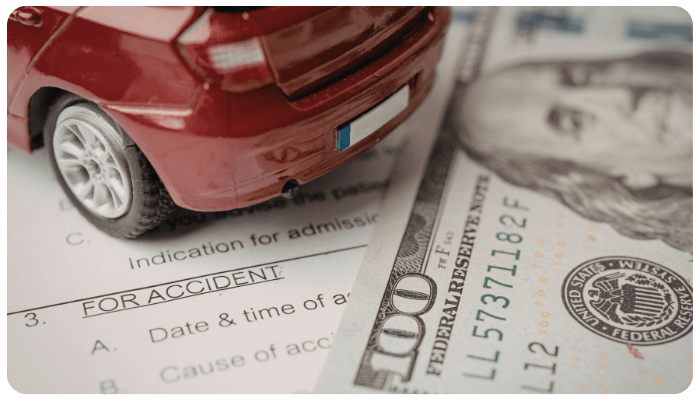
What Factors Influence the Payout? The Lawsuit Process and Legal Recourse
The payout depends on which damages the insurance companies accepts and which they dispute. Insurance companies frequently contest various items or at least their total amount. Since the burden of proof lies with the injured party, insurance companies may take advantage of the fact that certain damages are difficult to prove. Typically, determining the healing period of an injury or the duration for which a victim required a caregiver is a matter for a forensic medical expert. While most insurance companies have their own contracted experts, disputes regarding these items remain frequent.
Insurance companies generally prefer lump-sum settlements that close the case entirely. In such cases, they offer a one-time payment that may not cover all damages, knowing that the individual might not sue for the remainder or might prioritize receiving the money quickly.
If you do not accept the settlement (e.g., because it is insufficient or incomplete), you can request an itemized settlement. This means the insurance companies pays for the damages it accepts, and you can sue for the remainder. A lawsuit, however, is a long process that can take years.
In the event of a road accident, it is strongly recommended to sue the insurance companies rather than the individual perpetrator, as the insurance companies will join the litigation regardless. In personal injury lawsuits, the victim is usually entitled to the right to „record” duties, meaning they do not have to pay court fees upfront—a significant financial relief. Experts are typically involved to assess vehicle damage or the consequences of injuries, and the victim is usually required to advance these costs. However, if the victim wins the case, the insurance company will be ordered to reimburse these costs—including attorney fees—as part of the legal expenses, over and above the compensation itself. Consequently, it is not in the insurance company's interest to be sued, as the court may order them to pay substantial additional costs.
How Long Does It Take to Claim Compensation?
There is no exact answer without knowing the facts and the types of damage involved. If only a vehicle suffered minor damage, the insurance procedure is short: the adjuster names an amount, and the insurance company pays. If the accident involved personal injury, the total damage can only be determined at the end of the actual healing period, including whether future assistance will be necessary. The duration is also affected by how long it takes the police to establish facts that prove the perpetrator’s liability.
For complex accidents, it takes at least several months to receive meaningful compensation through out-of-court proceedings. Notably, this is not necessarily a bad thing; the passage of time can reveal further damages that were not immediately apparent, preventing the victim from rushing into a settlement that fails to cover future issues.
Lawsuits, on the other hand, can easily take 1.5 to 3 years.
Why Is a Personal Injury Lawyer Essential?
As shown above, compensation claims arising from road accidents can quickly become complex. A layperson may not be able to fully assess the extent of their damages or understand their rights and options in both out-of-court and judicial proceedings. Even after identifying the damages, the victim is responsible for quantifying them precisely and arguing for their necessity. Insurance companies can easily lead an unrepresented victim into a settlement that is unfavorable and prevents any further claims.
Our Law Firm helps you achieve the highest legally available compensation. We use our decades of experience to represent you before the insurance company, whether through out-of-court negotiations or in a court of law.